
The most critical factor in your physical recovery isn't what you put into your body, but rather what your body is capable of removing. When the lymphatic system becomes overwhelmed by the trauma of surgery or injury, the resulting stagnation doesn't just cause discomfort; it actively blocks the arrival of oxygen and nutrients required for cellular repair. You've likely noticed that standard rest isn't always enough to resolve persistent swelling or the early signs of internal scarring. Utilizing specialized lymphatic drainage for tissue healing shifts your recovery from a passive wait to an active, biological optimization.
It's understandable to feel concerned when tissue feels tight, lumpy, or unresponsive weeks after a procedure. You're looking for more than just temporary relief; you need a strategic approach that ensures your skin remains smooth and your mobility returns quickly. This guide breaks down the clinical science of Manual Lymphatic Drainage (MLD) and its role in preventing fibrosis and managing inflammation. We'll examine how precise, evidence-based techniques facilitate the transition from the inflammatory phase to the remodeling phase, ensuring your healing process is both thorough and efficient.
Key Takeaways
- Identify the physiological link between interstitial fluid management and the delivery of essential nutrients to repairing cells.
- Understand how the application of lymphatic drainage for tissue healing accelerates the transition from the inflammatory phase to the proliferative stage.
- Distinguish between recreational massage and clinical MLD to protect your delicate, newly formed lymph collectors from mechanical damage.
- Establish a professional recovery timeline for procedures such as Lipo 360 and tummy tucks to optimize tissue smoothness and mobility.
- Learn why specialized manual techniques are the clinical standard for preventing internal scarring and ensuring a safer return to daily activities.
The Biological Link Between Lymphatic Flow and Tissue Repair
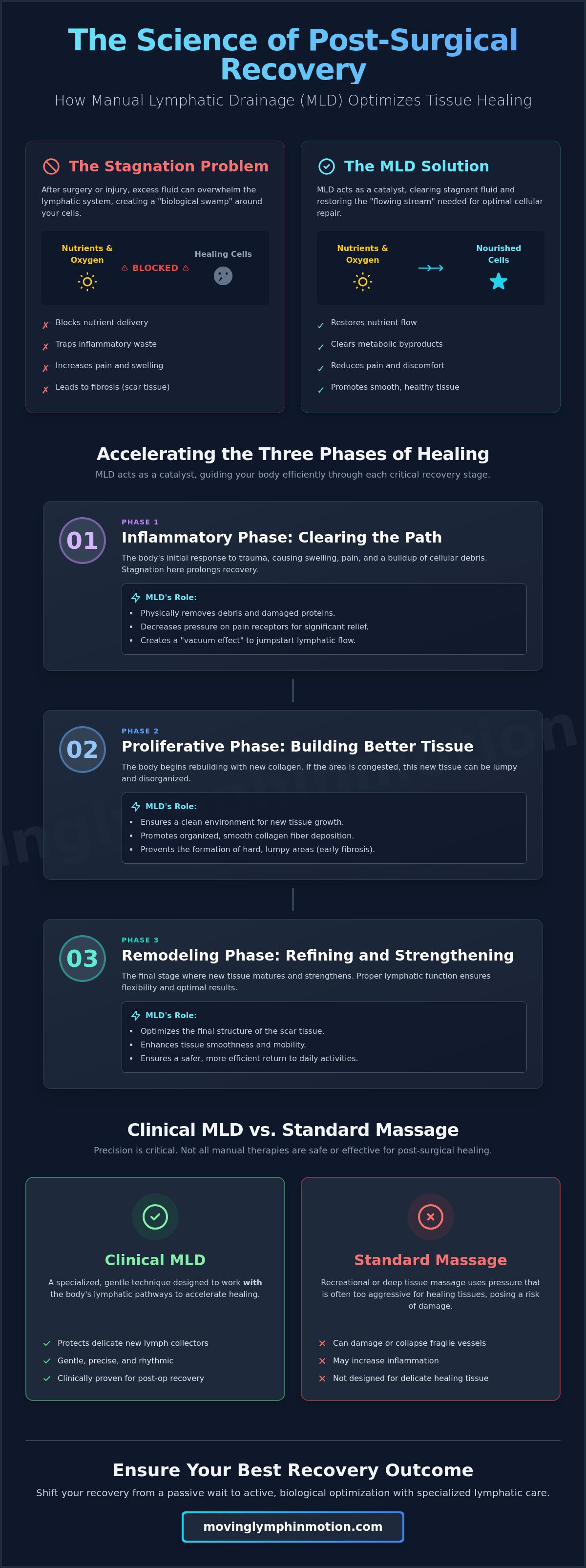
The lymphatic system serves as the body’s essential sanitation and logistics department, managing the intricate balance of fluid within the extracellular space. While many view it solely as a waste removal system, its primary function in recovery is the precise management of interstitial fluid to maintain cellular health. When this system fails to clear excess fluid, the resulting buildup creates mechanical pressure that directly impairs cellular oxygenation. Lymphatic drainage for tissue healing is a specialized manual technique designed to optimize the extracellular matrix by physically stimulating the movement of stagnant fluid and metabolic byproducts.
Beyond Waste Removal: Nutrient Delivery to Cells
The efficacy of tissue repair depends on the ability of local capillaries to deliver fresh oxygen and building blocks to the site of injury. Excessive interstitial fluid increases the pressure outside these microvessels, essentially squeezing them shut and preventing the delivery of vital nutrients. By reducing this hydrostatic pressure, Manual lymphatic drainage (MLD) restores the gradient necessary for capillary exchange. This process is particularly vital for protein transport; the lymphatic system is the only pathway through which large proteins can return to the blood circulation. Without this transport, the body can't effectively relocate the structural components required for new tissue synthesis. Stagnant fluid acts as a physical barrier, forcing nutrients to navigate a congested environment before reaching the cells that need them most.
The Inflammatory Stagnation Problem
Chronic swelling is not merely a cosmetic concern; it's a biochemical environment that actively degrades healthy tissue. When inflammatory mediators like cytokines and prostaglandins become trapped in the interstitial space, they continue to signal for an immune response, leading to secondary tissue damage and prolonged pain. A healthy lymphatic system functions like a clear, flowing stream that constantly refreshes the cellular environment. In contrast, stagnant lymph creates a biological swamp where metabolic waste and cellular debris accumulate. This congestion leads to localized hypoxia, a state where tissues are deprived of adequate oxygen despite its presence in the bloodstream. If this state persists, the body often responds by depositing disorganized collagen fibers, which eventually manifest as restrictive scar tissue or fibrosis. Utilizing lymphatic drainage for tissue healing interrupts this cycle by ensuring that the stream remains fluid and functional during the most critical phases of recovery.
Accelerating the Three Phases of Healing with MLD
Biological tissue repair follows a strict, sequential timeline: the inflammatory phase, the proliferative phase, and the remodeling phase. While these stages occur naturally, they aren't always efficient. Stagnant fluid can trap a patient in a state of chronic inflammation, stalling the transition to active repair. Clinical lymphatic drainage for tissue healing acts as a catalyst for this timeline. By manually assisting the movement of lymph, we can effectively shorten the inflammatory window and initiate the building of new tissue sooner. Early intervention, particularly within the first 14 days post-surgery, is critical for establishing a healthy recovery trajectory and preventing long-term complications.
The Inflammatory Phase: Clearing the Path
The inflammatory phase begins the moment trauma occurs. The body floods the site with white blood cells and specialized proteins to stabilize the area. However, this creates a high-pressure environment that can be incredibly painful. Clinical MLD protocols prioritize "clearing the nodes" in proximal, unaffected areas to create a vacuum effect. This technique helps accelerate wound healing by physically removing cellular debris and damaged proteins. As the excess fluid departs, the mechanical pressure on nociceptors (pain receptors) decreases. This provides significant relief and prevents the "stuck" feeling often reported in early post-op recovery.
The Proliferative Phase: Building Better Tissue
During the proliferative phase, the body focuses on rebuilding. Fibroblasts begin synthesizing new collagen to bridge the gaps in damaged tissue. If the area remains waterlogged, these collagen fibers are often deposited in a disorganized, "messy" fashion. This lack of organization is what leads to visible, thickened scars or internal lumps. Proper lymphatic flow ensures the tissue bed is well-hydrated but not congested. This balanced environment allows fibroblasts to lay down collagen in a more linear, functional pattern, which is essential for achieving smooth, flat results after procedures like a tummy tuck or Lipo 360.
The Remodeling Phase: Preventing Fibrosis
The final stage, remodeling, is where the body refines the newly formed tissue. Fibrosis, or a localized hardening of the tissue, occurs when the body over-deposits collagen in response to lingering inflammation. This is a common concern for patients undergoing post-operative cosmetic surgery recovery, particularly after liposuction. Specialized manual techniques are employed during this stage to soften existing adhesions and restore tissue elasticity. It's vital to understand that remodeling is a long-term process; it can continue for up to a year post-injury. Consistent care ensures that the tissue remains supple and does not develop the restrictive, "woody" texture associated with poorly managed surgical trauma.
Clinical MLD vs. Standard Massage: Why Precision Matters for Healing
Confusion often exists between recreational wellness massage and clinical Manual Lymphatic Drainage (MLD). While a deep tissue massage targets muscle groups to release tension, it can be counterproductive, or even dangerous, during the recovery phase. The initial lymphatics are delicate vessels located just beneath the skin's surface, held open by microscopic anchoring filaments. Applying the heavy pressure typical of standard massage can crush these fragile collectors, effectively halting the drainage process you're trying to encourage. Utilizing specialized lymphatic drainage for tissue healing requires a sophisticated understanding of these anatomical structures to ensure that the therapy supports, rather than hinders, the body's natural repair mechanisms.
The most common objection patients have is the surprisingly light touch used during a session. Clinical MLD utilizes a specific pressure, generally measured at 30 to 40 mmHg, which is just enough to stretch the skin without compressing the underlying vessels. Research into the biological link between lymphatic flow and tissue repair confirms that the system is highly sensitive to mechanical force. If the pressure is too high, the lymph capillaries collapse; if it's too low, the anchoring filaments aren't engaged. This precision is what distinguishes a medical-grade treatment from a spa service.
The Anatomy of a Lymphatic Stroke
Clinical practitioners use a specific "stretch and release" motion. The "stretch" phase creates a localized pressure change that encourages fluid to enter the lymphatic capillaries, while the "release" phase allows the vessel to pump that fluid forward. This movement must always follow a specific directional requirement, moving fluid toward the nearest functional node group. Because surgery often disrupts or severs existing pathways, a therapist must know how to reroute fluid to healthy drainage sites. This level of complexity is why professional lymphatic drainage for tissue healing requires advanced training and MLD certification to perform safely.
Risks of Incorrect Post-Op Massage
Improper technique following a surgical procedure carries significant risks. If a therapist "pushes" fluid into an area where lymphatic pathways have been severed, it can lead to the formation of seromas-pockets of trapped fluid that may require medical aspiration. Furthermore, aggressive massage can exacerbate internal bleeding or cause a hematoma. A clinical MLD specialist acts as a trained observer during your recovery journey, identifying early indicators of complications such as:
- Localized heat or redness that may suggest an emerging infection.
- Sudden, asymmetrical changes in swelling.
- Skin changes that could indicate tissue distress or necrosis.
By prioritizing physiological results over temporary relaxation, clinical MLD ensures a safer and more predictable path back to normal activities. This focus on functional recovery is a shared goal among specialist clinics worldwide; for instance, you can learn more about Functional Movement Physio and their approach to expert physiotherapy and sports injury rehabilitation.
Optimizing Your Recovery: When to Start and What to Expect
Timing is a decisive factor in the success of any manual intervention. For patients undergoing procedures like Lipo 360 or a tummy tuck, the window for implementing lymphatic drainage for tissue healing begins as soon as the initial surgical trauma stabilizes. Most clinical protocols recommend starting treatment within the first week, provided there are no contraindications such as active infections or blood clots. Initiating care early prevents the accumulation of protein-rich fluid from hardening into difficult-to-treat fibrosis. Before your first session, obtaining medical clearance from your surgeon is a mandatory safety step. Proper preparation also involves systemic support; staying well-hydrated is essential, as water intake reduces the viscosity of the lymph fluid, making it easier to transport through the vessels.
During the acute stage of healing, a "loading phase" of frequent sessions is often necessary. This intensive approach addresses the peak volume of post-surgical edema, ensuring the lymphatic system isn't overwhelmed by the sudden influx of fluid and cellular debris. You'll know the therapy is effective when you observe specific physiological changes. Increased urination is common immediately following a session as the body processes the mobilized fluid. Patients also report a significant reduction in the "heaviness" of the surgical site and a noticeable improvement in their range of motion as the internal pressure subsides.
The Post-Op Timeline for Austin Patients
Recovery is a sequential process that requires different therapeutic focuses at each stage. In the Austin clinical environment, we typically follow this progression:
- Day 3-7: Focus is on gentle, proximal clearing to manage acute edema and reduce pain.
- Weeks 2-6: Work becomes more targeted, addressing any emerging areas of hardness or "lumps" before they transition into permanent fibrosis.
- Long-term: Transition to maintenance care, which is especially vital for managing chronic conditions like lymphedema or lipedema.
Complementary Recovery Strategies
Clinical drainage doesn't exist in a vacuum. It works in direct synergy with proper compression garments and medical-grade foam, which provide the external resistance needed to keep fluid from re-accumulating in the interstitial spaces. Nutrition also plays a supporting role; an anti-inflammatory diet low in processed sodium helps prevent excessive water retention. Finally, simple diaphragmatic breathing exercises are encouraged to stimulate the "thoracic pump," which is the primary driver of central lymphatic flow. These combined efforts ensure the biological environment remains optimized for repair. If you are navigating the complexities of surgical recovery, you can book a clinical consultation to establish a personalized treatment plan.
Specialized Lymphatic Care: The Lymph in Motion Approach
Criselda White established Lymph in Motion to bridge the gap between surgical intervention and long-term physiological wellness. In the Central Texas medical community, surgeons frequently refer their patients to specialized practitioners because the precision of clinical lymphatic drainage for tissue healing is a critical component of the recovery protocol. This collaborative approach ensures that the surgical intent is preserved by managing the biological environment where healing occurs. Our "Build and Sculpt" philosophy reflects this commitment, prioritizing the underlying health of the tissue to enhance and maintain the aesthetic results achieved in the operating room. We don't just treat symptoms; we optimize the metabolic engine of your recovery.
Education is a cornerstone of our practice. We believe that a patient who understands their own fluid dynamics is better equipped to navigate the complexities of physical repair. By providing individualized attention and evidence-based guidance, we empower you with self-care knowledge that supports your lymphatic system for years to come. This focus on long-term health ensures that the benefits of your therapy extend far beyond the immediate post-operative window.
Clinical Expertise in Austin and Cedar Park
We provide specialized recovery services to residents across the region, including Austin, Cedar Park, Round Rock, Georgetown, and Liberty Hill. Working with a Certified Lymphatic Therapist (CLT) ensures that your care is grounded in advanced anatomical training. This distinction is vital, as a CLT possesses the technical skill to perform a personalized assessment of your tissue state and monitor scar progression with clinical accuracy. We look for subtle changes in skin texture and fluid volume that an untrained eye might miss, allowing for early intervention if the healing process deviates from the expected path.
Your First Session: A Path to Healing
Your journey begins with a comprehensive clinical intake and physical assessment. During this initial meeting, we review your surgical history, current medications, and specific recovery goals to create a targeted treatment plan. This methodical approach ensures that every manual technique used is appropriate for your current phase of healing. The environment at Lymph in Motion is intentionally calm and professional, designed to provide a sense of physical and emotional safety for individuals navigating the vulnerability of recovery. You are a partner in this process, and we prioritize clear communication at every stage of your therapy.
The clinical application of lymphatic drainage for tissue healing is an investment in the longevity of your results and the comfort of your daily life. If you're ready to transition from a passive recovery to an active, optimized healing journey, we invite you to take the first step toward clinical excellence. You can schedule your clinical lymphatic assessment in Austin today to ensure your tissues receive the specialized care they require.
Securing Your Path to Optimal Recovery
Effective recovery isn't a matter of chance; it's the result of strategic biological management. By understanding how lymphatic drainage for tissue healing facilitates nutrient delivery and prevents the formation of restrictive fibrosis, you can take control of your healing timeline. The transition from the inflammatory phase to the remodeling phase requires a meticulous approach that prioritizes physiological results over temporary comfort. Clinical precision ensures that your tissues remain supple, smooth, and functional as you return to your active lifestyle.
Strategic management also means looking at the body as an interconnected system; for instance, if you experience symptoms like throat tightness during your recovery, Precision Spinal Care offers valuable insights into how the upper neck might be part of that clinical story.
As a Certified Manual Lymphatic Drainage Practitioner, Criselda White specializes in post-operative cosmetic recovery, providing the expert guidance necessary to navigate the complexities of physical repair. Serving the Greater Austin area, including Cedar Park, Leander, and Round Rock, Lymph in Motion offers a dedicated partnership for your recovery journey. Don't leave your results to rest alone; give your body the clinical support it needs to thrive. Book Your Clinical Recovery Session with Criselda White to ensure your healing process is as thorough and efficient as possible. Your commitment to specialized care today establishes the foundation for your long-term physical health.
Frequently Asked Questions
Is lymphatic drainage for tissue healing painful after surgery?
Clinical MLD is not painful; it often reduces pain by lowering fluid pressure on nociceptors. If a treatment causes pain, the pressure is likely too high for delicate post-surgical tissues. Utilizing lymphatic drainage for tissue healing should feel like a rhythmic, soothing stretch of the skin rather than a deep or aggressive manipulation.
How many sessions of MLD do I need to see results in tissue healing?
While individual needs vary based on the extent of the surgery, a series of 10 to 12 sessions is a standard clinical recommendation for comprehensive recovery. Initial results, such as reduced heaviness and improved comfort, are typically felt after just one or two visits. A standard protocol often involves two to three sessions per week during the first month to address peak edema volume.
Can lymphatic drainage prevent scar tissue from becoming permanent?
Yes, by clearing trapped inflammatory mediators, lymphatic drainage for tissue healing prevents the disorganized collagen buildup that leads to permanent fibrosis. This intervention ensures that the remodeling phase of repair produces supple, smooth tissue rather than restrictive or lumpy adhesions. Consistent care during the first six weeks is essential for managing these long-term results.
How soon after a liposuction or tummy tuck can I start lymphatic drainage?
Most patients begin their first session between day 3 and day 7 following their procedure. This timing depends on your surgeon's specific clearance and the absence of complications like active infections or deep vein thrombosis. Early intervention is the most effective way to prevent the stagnation that leads to localized tissue hardness.
What is the difference between a spa lymphatic massage and clinical MLD?
The primary difference lies in medical education and technical application. Clinical MLD uses a precise pressure of 30 to 40 mmHg and is performed by a Certified Lymphatic Therapist who understands how to reroute fluid around severed pathways. Spa treatments often use recreational techniques that lack the anatomical precision required for medical-grade recovery.
Can I do lymphatic drainage on myself at home for healing?
Professional intervention is necessary for the complex fluid rerouting required after major surgery. While we teach specific self-care techniques for maintenance, home care cannot replace the clinical assessment of tissue progression. A trained therapist must identify the subtle signs of fibrosis or seroma formation that require specialized manual techniques.
Why do I feel thirsty or tired after a lymphatic drainage session?
Thirst and fatigue occur because your body is processing mobilized fluid and metabolic waste products. The therapy also triggers the parasympathetic nervous system, which induces a state of deep relaxation and systemic repair. It's essential to increase your water intake following a session to help your kidneys filter the mobilized proteins and debris.
Does lymphatic drainage help with bruising and hematomas?
MLD accelerates the clearance of blood byproducts and cellular debris from the interstitial space. This process significantly shortens the duration of visible bruising and helps resolve hematomas more efficiently by moving the components of the bruise toward functional lymph nodes. This prevents the inflammatory stagnation that can lead to localized tissue staining.


