A standard relaxation massage cannot resolve the physiological complexities of a post-operative patient or a client managing chronic lymphedema. If you feel limited by general wellness protocols, you aren't alone. Many practitioners find themselves hesitant when faced with the delicate tissue states and fluid dynamics of surgical recovery, fearing they lack the specific anatomical knowledge to ensure patient safety. Transitioning into clinical lymphatic therapy requires more than just a weekend workshop; it demands a rigorous mld practitioner certification course that aligns with medical-grade standards.
You deserve to feel confident in your clinical decisions while building a practice that Austin-area surgeons trust for their referrals. By specializing in evidence-based techniques, you can move away from aesthetic fluff and toward a career defined by measurable physiological results and higher professional rates. This guide explores how to choose a certification that bridges the gap between traditional Vodder methods and modern surgical requirements. We will break down the different training levels, the implications of the Lymphedema Treatment Act, and the path to becoming an indispensable clinical partner in the recovery journey.
Key Takeaways
- Distinguish between general wellness massage and clinical manual lymphatic drainage to address complex tissue states and fluid dynamics safely.
- Identify the essential curriculum components of a medical-grade mld practitioner certification course, focusing on advanced anatomy and surgical recovery adaptations.
- Learn how to evaluate accreditation and instructor expertise to ensure your training provides the clinical authority needed for high-stakes post-operative care.
- Discover strategies to integrate specialized lymphatic protocols into your service menu and establish professional referral networks with surgeons in the Austin area.
What is an MLD Practitioner Certification Course?
An mld practitioner certification course is a specialized post-graduate training program designed for licensed medical and massage professionals. It isn't a standard workshop or a general introduction to wellness techniques. Instead, it's a rigorous academic and practical deep dive into the lymphatic system's physiological functions. While many practitioners confuse lymphatic drainage with a relaxing spa treatment, true clinical Manual Lymphatic Drainage (MLD) is a targeted medical intervention. To understand the foundations of this specialized field, one must first address the question: What is Manual Lymphatic Drainage? It is a sophisticated methodology developed to stimulate the movement of lymph fluid, which is essential for patients with compromised systems or those recovering from trauma.
In 2026, the professional standards for this field have shifted. The rise in cosmetic surgeries and the implementation of the Lymphedema Treatment Act have created a significant demand for practitioners who understand more than just basic strokes. A medical-grade mld practitioner certification course focuses on several core objectives:
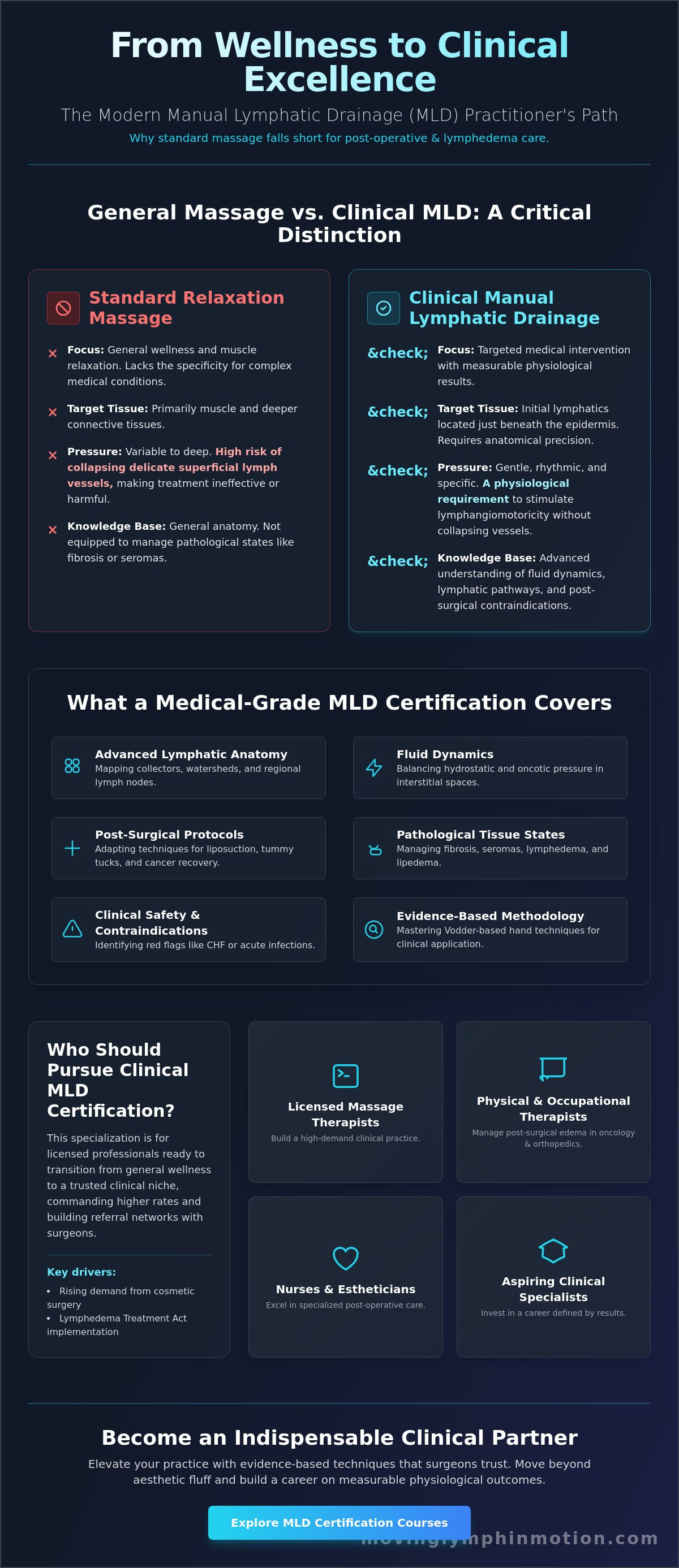
- Fluid Dynamics: Understanding the balance of hydrostatic and oncotic pressure within the interstitial space.
- Lymphatic Anatomy: Mapping the specific pathways of lymph collectors and the locations of regional lymph nodes.
- Pathological Tissue States: Identifying and managing conditions like fibrosis, seromas, and chronic edema.
- Clinical Methodology: Mastering the specific hand movements, such as stationary circles and pump techniques, that encourage lymphangiomotoricity.
The Difference Between MLD and General Lymphatic Massage
The primary distinction lies in anatomical precision. General massage often focuses on muscle tissue, but clinical MLD targets the initial lymphatics located just beneath the epidermis. Pressure dynamics are critical here. If you press too hard, you collapse the delicate lymph collectors, rendering the treatment ineffective. In a clinical setting, "gentle" isn't a preference; it's a physiological requirement for fluid transport. Additionally, practitioners must be able to identify contraindications. Performing MLD on a patient with untreated congestive heart failure or an active acute infection can lead to dangerous systemic complications. Professional certification ensures you can recognize these red flags before treatment begins.
Who Should Pursue MLD Certification?
This training is essential for Licensed Massage Therapists (LMTs) who want to move away from general wellness and establish a clinical niche. It's also vital for Physical and Occupational Therapists working in oncology or orthopedics to manage post-surgical edema. Nurses and estheticians who specialize in post-operative care also find these credentials necessary. By obtaining a recognized certification, these professionals can safely manage recovery paths for patients following procedures like liposuction, tummy tucks, or breast cancer surgeries, ensuring that the healing process is both efficient and evidence-based.
Core Curriculum: What to Expect in a Medical-Grade MLD Course
A medical-grade mld practitioner certification course must move beyond the surface. It requires a comprehensive understanding of how the lymphatic and circulatory systems work in tandem to maintain fluid homeostasis. You will study the anatomy of lymph collectors and the delicate mechanics of the initial lymphatics, where fluid first enters the system. This curriculum includes a deep dive into the pathology of conditions like lymphedema, lipedema, and systemic edema. For instance, the National Cancer Institute provides extensive data on lymphedema as a chronic condition, highlighting why manual drainage is a critical component of complex decongestive therapy.
While the original Vodder Method remains the gold standard foundation, a modern mld practitioner certification course must adapt these techniques for today’s clinical needs. Traditional hand sequences for the head, neck, torso, and extremities are essential, but they must be refined to address the specific tissue trauma found in current surgical environments. Practical application focuses on mastering the precise pressure and rhythm needed to stimulate lymphangiomotoricity. This ensures that the practitioner can move fluid effectively without causing further inflammation or discomfort to the patient.
Specialized Protocols for Post-Cosmetic Surgery
Post-operative care is one of the most demanding applications of MLD. You will learn to manage acute inflammation following Liposuction and BBL procedures. This isn't just about reducing swelling. It involves specialized techniques to prevent and treat post-op fibrosis, which is the formation of thick, restrictive scar tissue. Understanding how surgical incisions alter natural drainage pathways allows you to reroute fluid safely toward healthy lymph nodes. If you're ready to master these advanced skills, exploring professional lymphatic training can provide the clinical edge your practice needs.
Clinical Assessment and Documentation
A specialist's value lies in their ability to measure and report results. A clinical course teaches you how to perform a professional intake that considers a patient’s full medical history and current physical state. You'll learn standardized measurement protocols, such as girth measurements and tissue palpation, to track progress objectively. Writing precise clinical notes is vital for building trust with referring surgeons. These notes serve as a professional bridge, ensuring the physician understands the patient’s recovery trajectory through clear, anatomical language and data-driven observations.
Comparing MLD Certifications: How to Choose the Right Program
The current educational market is saturated with various training options, making the selection of an mld practitioner certification course a critical professional decision. Choosing a program that lacks clinical depth doesn't just waste your time; it leaves you unprepared for the physiological realities of a patient in recovery. To ensure your education meets medical-grade standards, you must look beyond marketing promises and evaluate the underlying anatomical validity of the curriculum.
Accreditation serves as your first benchmark. Verify that the course provides Continuing Education Units (CEUs) approved by the National Certification Board for Therapeutic Massage & Bodywork (NCBTMB) or your specific state board. However, accreditation is only the baseline. The true value of a certification lies in the instructor's active clinical experience. You should learn from someone who currently manages complex cases, rather than someone who only teaches theory. According to the Mayo Clinic, manual lymph drainage is a sophisticated therapeutic intervention used to move fluid from swollen areas to functioning lymph vessels. Mastering this requires a deep understanding of anatomical pathways that can only be conveyed by a practicing specialist who understands tissue dynamics.
Tactile feedback is non-negotiable for clinical mastery. While online theory is helpful for learning history and basic biology, the "skin stretch" technique essential to MLD cannot be mastered through a screen. You need an instructor to physically correct your hand placement, pressure, and rhythm in real time. Without this precise adjustment, you risk applying too much pressure and collapsing the very lymph collectors you intend to stimulate, which can stall the patient's healing process.
The 'Gold Standard' Checklist for MLD Training
A high-quality mld practitioner certification course should prioritize precision and individualized instruction. When vetting a program, verify the instructor's clinical background and active practice status. Small class sizes are essential because they allow for personalized manual technique correction. This ensures your hands learn the exact "feel" of healthy versus fibrotic tissue. Finally, seek out programs that offer post-course support or mentorship opportunities. The transition into clinical practice often brings complex questions that require expert guidance to navigate safely.
Avoiding 'Weekend Wonder' Courses
Short, 8-12 hour workshops are insufficient for achieving true clinical competency. These "weekend wonders" often gloss over the deep anatomical training required to handle post-operative complications or chronic pathologies. Practicing MLD without a comprehensive understanding of the lymphatic system's mechanics puts your patients at risk. Spotting "fluff" certifications is often simple. If the program focuses more on aesthetic "detox" trends than on physiological fluid dynamics and contraindications, it likely lacks the medical validity needed for a serious clinical practice.
Implementing MLD in Your Practice: From Student to Specialist
Completing an mld practitioner certification course is the foundational step toward clinical specialization. The next challenge is integrating these advanced skills into your practice in a way that reflects your new expertise. You shouldn't simply add "lymphatic massage" as a sub-item under general wellness services. This creates confusion and devalues the technical nature of the work. Instead, position MLD as a clinical intervention. This shift allows you to command premium rates because clients aren't paying for relaxation; they're paying for specialized fluid management and accelerated healing. High-level practitioners often set rates that reflect the extensive training required to handle pathological tissue and post-surgical complications safely.
Networking within the Central Texas medical community requires a commitment to professional excellence. By establishing yourself as a knowledgeable specialist, you become a vital part of the patient's recovery team. If you're ready to transition your career from general massage to clinical excellence, consider the professional lymphatic certification programs available through Lymph in Motion by Criselda White. This path allows you to move beyond the limitations of the general wellness market and into a rewarding clinical niche.
Building a Referral Network in Central Texas
Central Texas is a hub for elective and reconstructive surgery, particularly in Austin, Cedar Park, and Round Rock. To build a sustainable practice, you must speak the language of the surgeons who operate there. When approaching a plastic surgeon's office, focus on how your work supports their "standard of care." Use clinical terms like "reducing post-operative seroma risk" or "mitigating acute inflammatory responses." Provide them with professional marketing materials that outline your certification and specific protocols for procedures like liposuction or abdominoplasty. Surgeons value partners who understand the physiological timeline of a surgical incision and can provide measurable data on a patient's recovery.
Clinical Manual Lymphatic Drainage: Professional Standards
Your environment must mirror your clinical authority. A professional MLD space prioritizes hygiene and patient safety over aesthetic fluff. This includes using specialized hydraulic tables that allow for proper patient positioning and ergonomic body mechanics for the practitioner. You should also be prepared to provide compression education, as MLD and compression are often inseparable in a clinical setting. Professional manual lymphatic drainage is a non-invasive, evidence-based intervention for fluid management. This standard ensures that every touch has a physiological purpose, moving away from recreational touch and toward therapeutic results.
Professional MLD Training at Lymph in Motion by Criselda White
Selecting the right mld practitioner certification course is a significant commitment to your professional evolution. At Lymph in Motion by Criselda White, we provide a mentorship-based training environment that bridges the gap between traditional theory and modern clinical application. This approach focuses on the critical intersection of medical-grade manual lymphatic drainage and aesthetic recovery. It ensures that you aren't just learning a sequence of strokes, but rather understanding the biological response to surgical trauma and chronic pathology. Our curriculum is designed for practitioners who prioritize physiological results, moving beyond recreational basics into a space of true clinical mastery.
Hands-on training in Austin allows for personalized instruction that simply cannot be replicated in an online-only format. You'll receive direct feedback on your manual technique, ensuring that your pressure and rhythm are precise enough to stimulate lymphangiomotoricity without causing further tissue stress. This real-world application prepares you to handle the complexities of a clinical practice immediately upon completion. By training with us, you join a community of elite practitioners in Central Texas who are dedicated to setting a higher standard for lymphatic care.
Why Choose Lymph in Motion by Criselda White for Your Certification?
Our program is built on the reality of today's clinical demands. By joining our course, you gain direct access to clinical manual lymphatic drainage standards that emphasize safety and anatomical accuracy. We've tailored our curriculum to specifically address post-op lymphatic drainage Austin needs, ensuring you can manage the unique recovery paths of cosmetic surgery patients. Beyond aesthetics, our training provides the skills necessary to treat complex cases, including fibrosis, lipedema, and post-mastectomy care, making you a versatile and highly skilled specialist.
Start Your Clinical Journey Today
Transitioning from a general wellness practitioner to a certified specialist requires a structured and evidence-based path. We offer a comprehensive mld practitioner certification course that meets the rigorous requirements for professional practice. Enrollment requires an active license in a relevant medical or therapeutic field, ensuring that all students share a baseline of anatomical knowledge. The Lymph in Motion by Criselda White difference lies in our commitment to your long-term success through ongoing mentorship and a focus on measurable patient outcomes. If you're ready to elevate your practice and provide the level of care that Austin-area surgeons expect, it's time to take the next step.
Advancing Your Practice with Clinical Authority
Transitioning from general wellness massage to clinical manual lymphatic drainage is a profound shift in professional identity. It requires moving beyond recreational techniques toward a rigorous, evidence-based understanding of fluid dynamics and tissue states. By prioritizing a medical-grade education, you ensure that your work is both safe and effective for patients navigating the complexities of surgical recovery or chronic pathologies. Choosing the right mld practitioner certification course isn't just about obtaining a credential; it's about gaining the precision needed to achieve measurable physiological results.
Our program is taught by post-op recovery specialist Criselda White and offers small-group clinical mentorship designed to prepare you for the highest standards of the medical community. We focus on medical-grade surgical recovery protocols that empower you to handle complex cases with confidence. If you're ready to elevate your career and join an elite network of specialists, we invite you to Enroll in the Next Clinical MLD Certification Course. Your journey toward clinical excellence and professional specialization starts here.
Frequently Asked Questions
What are the prerequisites for an MLD practitioner certification course?
Prerequisites typically include an active professional license in a healthcare or therapeutic field, such as massage therapy, physical therapy, occupational therapy, or nursing. This ensures you possess a foundational understanding of anatomy and physiology before beginning specialized training. Some advanced programs also require the completion of an introductory MLD basics course to establish a baseline of manual skills.
How long does it take to become a certified MLD practitioner?
The timeline for completion depends on the specific level of specialization you intend to achieve. A foundational mld practitioner certification course often involves 40 to 45 hours of intensive study and practical application. More comprehensive paths, such as becoming a Certified Lymphedema Therapist (CLT), generally require 135 or more hours of clinical training to meet hospital and insurance standards.
Is an online MLD certification as valid as in-person training?
Online training is highly effective for learning theoretical components like fluid dynamics and lymphatic anatomy, but in-person training is necessary for manual mastery. The precise "skin stretch" technique essential to MLD requires immediate tactile feedback from a qualified instructor. Clinical employers usually prioritize practitioners who have completed hands-on hours to ensure they can manage delicate post-operative tissues safely.
Can I use MLD certification to work in a hospital or surgical center?
You can use your certification to work in medical environments, though hospital settings often require the more extensive CLT designation for treating complex lymphedema. Surgical centers specifically seek practitioners who understand post-operative protocols for procedures like liposuction or mastectomies. Having a recognized clinical credential establishes the professional trust necessary to collaborate with surgeons and medical recovery teams.
Do I need to renew my MLD certification periodically?
Most reputable certification bodies require renewal every two to three years to ensure practitioners remain current with evolving clinical standards. This process typically involves completing a specific number of continuing education hours or attending a recertification workshop. Regular renewal maintains the integrity of your credentials and ensures you're applying the most recent evidence-based methodologies in your practice.
What is the average salary increase for a certified MLD therapist?
While specific income changes vary by region and clinical setting, specializing in lymphatic therapy allows practitioners to command higher professional rates. Industry professionals report that moving from general wellness into a specialized medical niche often leads to increased revenue through higher per-session fees. Specialization reduces competition and increases your value as a clinical expert in the eyes of referring physicians.
Will this course teach me how to treat lymphedema and lipedema?
Yes, a comprehensive mld practitioner certification course includes training on the pathology and management of both lymphedema and lipedema. You'll learn to distinguish between these conditions and apply the appropriate manual techniques to manage fluid volume and tissue fibrosis. This knowledge is essential for providing effective care to patients with chronic lymphatic disorders or those experiencing post-cancer treatment swelling.
How many CEUs can I earn from a professional MLD course?
The number of Continuing Education Units (CEUs) earned varies depending on the program's length and accreditation status. Foundational courses often provide between 16 and 32 CEUs, while full certification programs can offer 45 or more. It's important to verify that the course is approved by the NCBTMB or your specific state licensing board to ensure the credits apply toward your professional requirements.


