

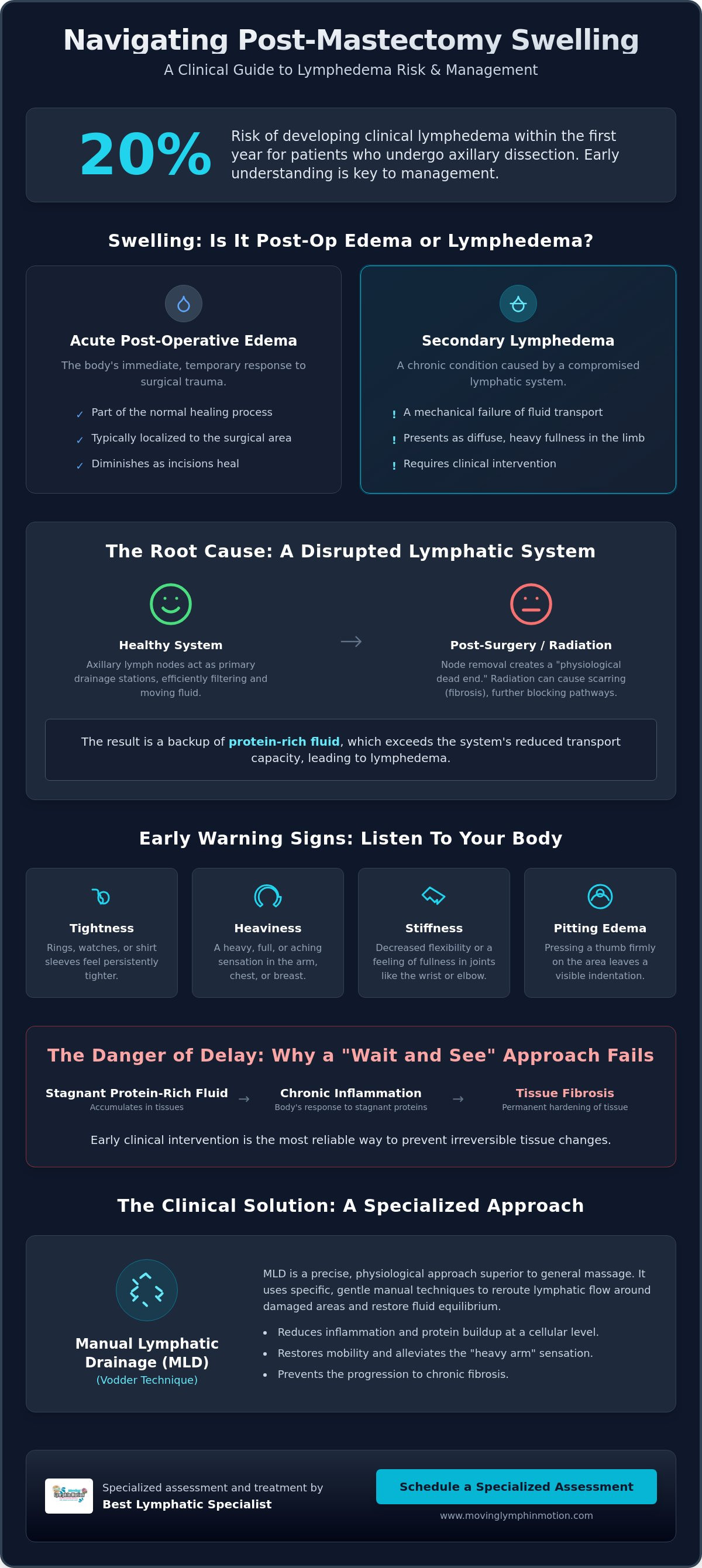
For patients who undergo axillary dissection, the risk of developing clinical lymphedema within the first year is as high as 20 percent. This statistic often brings a sense of clinical anxiety, especially when you're already managing the physical heaviness and restricted range of motion that follows surgery. It's difficult to discern where normal post-operative inflammation ends and where a chronic lymphatic condition begins. You deserve a clear, medical-grade understanding of your body’s altered fluid dynamics to ensure you aren't just guessing at your recovery.
We understand that achieving lasting post-mastectomy swelling relief requires more than general wellness advice; it demands a precise, physiological approach. This article provides a clinical roadmap for your recovery, explaining the biological causes of fluid accumulation and the specific manual techniques used to restore lymphatic health. You'll learn how Manual Lymphatic Drainage (MLD) functions at a cellular level to reduce inflammation and restore mobility in the affected limb. By the end of this guide, you'll have a structured plan for long-term management that prioritizes your physical comfort and clinical safety.
Key Takeaways
- Distinguish between acute post-operative edema and secondary lymphedema to better understand your body’s specific healing timeline.
- Understand how the removal of lymph nodes affects fluid equilibrium and why stagnant, protein-rich fluid requires clinical intervention to prevent tissue fibrosis.
- Discover how Clinical Manual Lymphatic Drainage (MLD) uses the Vodder technique to provide effective post-mastectomy swelling relief by manually rerouting lymphatic flow.
- Learn the critical role of medical-grade compression garments and professional guidance in maintaining a safe environment for long-term lymphatic health.
- Identify why a specialized, anatomical approach is superior to general massage for restoring range of motion and managing chronic swelling.
Understanding Post-Mastectomy Swelling: Lymphedema vs. Edema
Post-mastectomy recovery involves a complex physiological transition that extends far beyond the surgical site. When the body undergoes oncology surgery, the delicate equilibrium of fluid transport is fundamentally altered. Understanding the difference between temporary inflammation and a chronic lymphatic condition is the first step toward achieving effective post-mastectomy swelling relief. This clarity allows you to approach your recovery with clinical precision rather than guesswork.
Acute post-operative edema is the body's immediate, inflammatory response to surgical trauma. This type of swelling is typically localized and tends to diminish as the primary incisions heal and the initial inflammatory cascade subsides. In contrast, What is Lymphedema? It's a secondary condition characterized by a mechanical failure of the lymphatic system. While edema is a symptom of healing, lymphedema represents a long-term disruption where the lymphatic load exceeds the system's transport capacity due to structural changes.
The Role of Axillary Lymph Nodes
The axillary lymph nodes serve as the primary drainage stations for the upper extremities and the lateral chest wall. In clinical terms, these nodes act as the essential drainage outlets for specific anatomical regions known as watersheds. When nodes are removed or damaged during an axillary dissection, the natural map of fluid movement is erased. Fluid that previously flowed toward the axilla now encounters a physiological dead end, leading to a backup in the arm, breast, or chest wall. Radiation therapy often complicates this further by causing tissue fibrosis; this scarring restricts the remaining vessels and limits their ability to compensate for the missing nodes.
Signs You Should Seek Clinical Intervention
Identifying the transition from normal healing to a clinical concern requires careful observation of tissue states. One of the most common early warning signs is a persistent "heavy arm" sensation, even if visible swelling isn't yet obvious. Patients often report subtle changes in how their body feels before a clinician can measure a change in limb girth. Watch for these specific indicators:
- Persistent tightness in rings, watches, or shirt sleeves that wasn't present before.
- A "heavy" or "aching" sensation in the limb that worsens by the end of the day.
- Decreased flexibility or a feeling of "fullness" in the wrist, elbow, or chest.
- Pitting edema: This occurs when pressing your thumb firmly into the swollen area for five seconds leaves a visible indentation after you release.
It's also vital to distinguish generalized swelling from a seroma. A seroma is a localized pocket of clear serous fluid that often feels like a fluctuant "water balloon" near the incision site, whereas lymphedema presents as a more diffuse, heavy fullness throughout the limb. Early intervention through clinical manual techniques is the most reliable way to manage these symptoms and prevent them from progressing into permanent tissue changes. You can schedule a specialized assessment to begin your journey toward recovery at Best Lymphatic Specialist, where we prioritize physiological results and long-term post-mastectomy swelling relief.
The Physiology of Lymphatic Flow After Oncology Surgery
The lymphatic system functions as the body's secondary circulatory network, responsible for maintaining fluid balance and immune surveillance. When oncology surgery removes lymph nodes, it effectively "breaks the pump" by eliminating the primary drainage outlets for the affected quadrant. This mechanical failure disrupts the delicate pressure gradients that allow fluid to move from the tissues back into the venous system. Without these outlets, the limb's transport capacity is permanently reduced, making professional post-mastectomy swelling relief a physiological necessity rather than an elective choice.
The fluid that accumulates isn't merely water; it's a protein-rich substance that creates high osmotic pressure within the tissue. If this fluid remains stagnant, it triggers a chronic inflammatory response that eventually leads to tissue fibrosis, or hardening. The National Cancer Institute guide to lymphedema emphasizes that this protein accumulation can alter the local environment, making the area more susceptible to infection and permanent structural changes. Scar tissue from surgery and radiation further complicates this by creating physical barriers that block the remaining collateral pathways.
Interstitial Fluid Dynamics
Interstitial fluid is the clear liquid found in the microscopic spaces between tissue cells that, when left uncollected by a compromised lymphatic system, begins to accumulate and exert pressure on surrounding structures.
This accumulation marks the transition from simple fluid swelling to a more complex state of tissue hardening. As proteins settle into the interstitial space, they act as a scaffold for connective tissue growth, which thickens the skin and underlying layers. Many patients adopt a "wait and see" approach, but this delay often allows fibrosis to become established. Once tissue hardens, it's significantly more difficult to achieve the same level of post-mastectomy swelling relief that early intervention provides.
Collateral Circulation and Compensation
The human body is remarkably adaptive and will attempt to reroute fluid away from the damaged area toward healthy lymph node groups. This process involves navigating "lymphatic watersheds," which are anatomical boundaries that naturally divide the body's drainage zones. Clinical techniques focus on encouraging this rerouting by manually stimulating these collateral pathways. For a deeper look at how this process manages systemic responses, you can read about Manual Lymphatic Drainage for Inflammation from a clinical perspective.
Oncology treatments like radiation can also impair the contractility of the remaining lymph vessels, making it harder for the body to compensate on its own. Professional intervention helps bridge this gap by providing the external stimulus required to move fluid across these watersheds. If you're noticing a persistent sense of fullness or restricted movement, scheduling a clinical evaluation can help identify the best compensatory strategies for your specific anatomy.
Clinical Manual Lymphatic Drainage (MLD): The Gold Standard for Relief
While recreational massage focuses on the manipulation of muscle tissue, Clinical Manual Lymphatic Drainage (MLD) is a specialized medical therapy designed to influence fluid dynamics. For patients seeking post-mastectomy swelling relief, this distinction is vital for safety and efficacy. Traditional massage often involves deep pressure that can collapse fragile lymphatic vessels or increase local blood flow, which may inadvertently worsen swelling in a compromised limb. Clinical MLD, specifically the Vodder technique, utilizes a precise, rhythmic skin-stretching method that targets the superficial lymphatic system without causing tissue trauma.
The primary objective of MLD in a post-oncology context is to manually reroute fluid. Since surgery may have removed the primary drainage outlets, a specialized therapist must guide the stagnant lymph toward functional node clusters in healthy quadrants of the body. This process requires an intimate understanding of your specific surgical history and the altered "map" of your lymphatic system. By following CDC tips for living with lymphedema and engaging in professional MLD, you can manage your condition with the highest standard of evidence-based care.
The Mechanics of a Clinical MLD Session
A clinical session follows a strict anatomical logic that prioritizes the "opening" of proximal node groups before treating distal swelling. A therapist begins by stimulating healthy lymph nodes in the neck or the unaffected axilla to clear the path. This creates a vacuum effect, allowing fluid from the swollen arm or chest to move more easily. Deep pressure is strictly contraindicated because the lymphatic collectors are located just beneath the skin; excessive force can temporarily shut these vessels down. Instead, the therapist uses light, directional stretching to stimulate the lymph angions. These are the tiny muscular units within the lymph vessels that act as individual pumps, and manual stimulation increases the frequency of their contractions to move fluid across the watersheds.
Benefits Beyond Swelling Reduction
The physiological impact of MLD extends far beyond mere volume reduction. The rhythmic and gentle nature of the technique stimulates the parasympathetic nervous system, which helps lower the clinical anxiety often associated with post-operative recovery. This systemic relaxation response is a powerful tool for pain management. Furthermore, MLD is essential for softening surgical scar tissue. By moving protein-rich fluid through the area, it prevents the stagnation that leads to fibrosis and restricted range of motion. For a deeper understanding of how these clinical protocols fit into your recovery journey, explore our guide on Clinical Lymphatic Drainage for Breast Cancer. This specialized approach ensures that every movement is purposeful, respecting the delicate state of your healing tissues while restoring functional mobility.
How to Support Your Recovery at Home: Practical Relief Steps
Clinical intervention provides the foundation for recovery, but the maintenance of lymphatic health is a continuous process that extends into your daily environment. Supporting your body’s altered drainage map requires a disciplined approach to skin care, movement, and compression. These home-based protocols are designed to protect the integrity of the tissue and optimize the transport capacity of your remaining vessels. Consistency in these practices is an essential component of long-term post-mastectomy swelling relief.
The primary goal of home care is to prevent the re-accumulation of protein-rich fluid in the interstitial spaces. Stagnant fluid increases the risk of infection and tissue hardening, making proactive management a clinical necessity. By implementing a structured routine, you can maintain the results achieved during your Manual Lymphatic Drainage sessions and reduce the physical heaviness in the affected limb.
Daily Lymphatic Support Checklist
Effective management begins with simple but physiologically significant habits. Consider the following daily priorities:
- Hydration: Adequate water intake is critical for maintaining the proper viscosity of lymphatic fluid. Dehydration can cause the lymph to become thicker and more difficult for a compromised system to transport.
- Elevation: Proper elevation utilizes gravity to assist venous and lymphatic return. Ensure the limb is supported above the level of the heart without creating tension in the shoulder or neck. A common mistake is allowing the hand to hang lower than the elbow, which encourages distal pooling.
- Monitoring Red Flags: Inspect the skin daily for "red flag" symptoms. Sudden redness, localized heat, or a rapid increase in swelling can indicate cellulitis, a bacterial skin infection that requires immediate medical attention for those with lymphatic impairment.
Compression Basics for Survivors
Medical-grade compression is a non-negotiable tool for managing lymphedema. These garments provide a stable counter-pressure for the muscles to work against, which significantly enhances the "muscle pump" mechanism during movement. There is a critical distinction between the reduction phase and the maintenance phase of recovery. During active reduction, multi-layer bandaging is often required to move large volumes of fluid. Once the limb volume has stabilized, a custom-fitted daytime sleeve is used to maintain those results.
Professional fitting is vital. An ill-fitting garment can create a "tourniquet effect" at the wrist or elbow, further obstructing fluid flow rather than assisting it. Since the implementation of the Lymphedema Treatment Act, access to these essential supplies has improved, making it easier to secure the medical-grade tools you need. For those navigating these complexities in Central Texas, our guide on Lymphedema Therapy Austin TX provides a localized roadmap for professional management. To ensure your home care routine is optimized for your specific anatomical needs, you can schedule a clinical fitting or consultation to refine your recovery strategy.
Personalized Breast Cancer Recovery in Austin and Central Texas
The transition from active oncology treatment to long-term survivorship requires a shift in clinical focus. While surgery and radiation are essential for oncology care, they often leave the lymphatic system in a state of compromised transport capacity. For survivors in Central Texas, localized, specialized care is a fundamental component of managing these physiological changes. Accessing professional post-mastectomy swelling relief within your own community ensures that you can maintain a consistent treatment schedule without the added physical strain of long-distance travel, which is vital for stabilizing tissue states.
At Best Lymphatic Specialist, we provide a clinical bridge for patients moving from acute surgical recovery to restorative manual therapy. Our approach serves individuals across Austin, Cedar Park, and Georgetown, offering a sophisticated alternative to standardized wellness services. We recognize that every surgical history is unique; therefore, your recovery roadmap must be equally individualized to account for specific node dissections, radiation fields, and scar tissue patterns.
Your Clinical Partner in Central Texas
Clinical expertise is the most critical factor in achieving measurable results. Criselda White specializes in oncology-related lymphatic drainage, bringing a deep anatomical understanding to every session. During your initial clinical evaluation, we perform a comprehensive assessment of your tissue integrity and limb volume. We don't just treat the symptoms; we analyze your surgical history to understand how fluid has been rerouted and where the "broken pumps" are located. This evaluation allows us to build a customized treatment plan that prioritizes the restoration of your range of motion and the reduction of interstitial pressure.
Our methodology is grounded in evidence-based practice. With the implementation of the Lymphedema Treatment Act in 2024, and the subsequent billing updates in 2026, there is now a clearer path for survivors to access the medical-grade compression supplies necessary for maintenance. We help you navigate these clinical requirements, ensuring that your manual therapy is supported by the correct physiological tools for long-term health.
Scheduling Your Recovery Path
Consistency is the primary driver of success in the early phases of Manual Lymphatic Drainage. To achieve significant post-mastectomy swelling relief, the lymphatic system requires regular, rhythmic stimulation to encourage the development of collateral pathways. Skipping sessions during the initial reduction phase can allow protein-rich fluid to re-stagnate, potentially leading to the tissue hardening discussed in previous sections. By committing to a structured clinical protocol, you're actively preventing the progression of secondary lymphedema.
You deserve a recovery process that prioritizes your physical comfort and functional mobility through expert, anatomical care. Taking the first step toward clinical management empowers you to regain control over your body’s healing journey. We invite you to book your clinical lymphatic session via Vagaro and begin a personalized path toward lasting relief and restored vitality.
Advancing Your Clinical Recovery Path
Managing the physiological changes following oncology surgery requires a transition from passive healing to active, clinical management. By distinguishing between temporary edema and secondary lymphedema, you've taken the first step toward a targeted recovery. We've explored how the Vodder technique manually reroutes fluid across watersheds, providing essential post-mastectomy swelling relief while preventing the onset of tissue fibrosis and permanent structural changes.
You don't have to navigate these anatomical complexities alone. As a Certified Lymphatic Therapist specializing in post-oncology protocols, I provide the meticulous, evidence-based attention your body needs to restore fluid equilibrium. Whether you're in Austin, Cedar Park, or Georgetown, specialized care is within reach to support your long-term lymphatic health. Schedule Your Clinical Lymphatic Evaluation in Austin to begin a structured plan tailored to your specific surgical history.
Reclaiming your range of motion and physical comfort is a tangible goal. With the right clinical partner and a commitment to specialized manual therapy, you can move forward with confidence in your body's ability to heal and thrive.
Frequently Asked Questions
Is it normal to have swelling after a mastectomy?
Yes, acute inflammation is a standard physiological response to the trauma of surgery. This initial edema occurs as the body delivers healing cells to the incision site to begin tissue repair. While this is expected, you must monitor the area closely to ensure the swelling doesn't transition from a temporary inflammatory phase into a chronic condition.
How long does post-mastectomy swelling usually last?
Acute post-operative edema typically subsides within six to twelve weeks as the primary incisions heal and the lymphatic system begins to compensate. If you notice swelling that persists beyond this window, or if it appears months or even years after your treatment, it likely indicates the onset of secondary lymphedema. Monitoring your limb volume during this timeframe is critical for maintaining long-term health.
Can manual lymphatic drainage help with post-op fibrosis?
Manual Lymphatic Drainage is highly effective at softening fibrotic tissue by manually moving the protein-rich fluid that contributes to tissue hardening. By reducing interstitial pressure and clearing stagnant proteins, MLD prevents the further development of the connective tissue scaffolds that cause skin thickening. This clinical intervention is a primary tool for achieving lasting post-mastectomy swelling relief and restoring skin elasticity.
Will insurance cover lymphedema therapy in Austin?
Coverage varies by provider, but the Lymphedema Treatment Act has significantly expanded Medicare Part B coverage for essential compression supplies as of 2024. Many private insurers follow these federal guidelines regarding medical necessity. While many specialized clinics operate on a private-pay basis, they can often provide the clinical documentation required for you to seek out-of-network reimbursement from your insurance carrier.
How soon after surgery can I start lymphatic drainage?
You can often begin gentle MLD as early as one to two weeks post-surgery, provided your surgical team has cleared you for manual therapy. Early intervention focuses on clearing the proximal node groups to assist with acute post-mastectomy swelling relief. This approach avoids direct pressure on the fresh incision site while encouraging the body to reroute fluid through healthy collateral pathways.
What is the difference between a seroma and lymphedema?
A seroma is a localized collection of serous fluid that forms a distinct, fluctuant pocket near the incision or axilla. Lymphedema is a diffuse accumulation of fluid throughout the entire limb or chest wall caused by a mechanical failure of the lymphatic transport system. While a seroma is often a temporary post-surgical complication, lymphedema is a chronic condition that requires long-term clinical management.
Does post-mastectomy swelling always mean I have lymphedema?
Not every instance of swelling indicates a chronic condition. Swelling can result from temporary post-operative inflammation, a localized seroma, or even a minor infection. However, because oncology surgery and radiation fundamentally alter your anatomical drainage map, any persistent fullness should be evaluated by a specialist to prevent the progression of permanent tissue changes.
Can I perform lymphatic drainage on myself at home?
Self-lymphatic massage is an excellent maintenance tool, but it should only be performed after you've received professional instruction from a certified therapist. It's vital to learn the correct sequence and pressure to avoid pushing fluid into congested areas. A clinician can teach you specific techniques that respect your unique surgical watersheds and utilize your remaining functional drainage outlets.